
What Is Hot Wedge Welding?
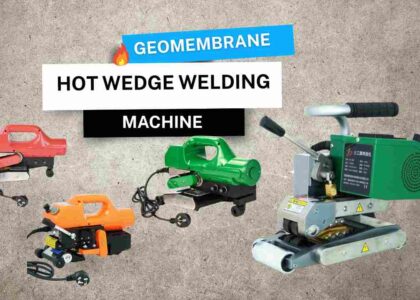
Hot wedge welding is a thermal fusion process that joins overlapping thermoplastic sheets by drawing them across a heated metal wedge, then immediately pressing the molten surfaces together between counter-rotating pressure rollers. Because heat is applied from between the sheets — not blown on from outside — the melt zone is protected from wind, dust and moisture, which is why hot wedge welding is the specified method for production seams on virtually every HDPE geomembrane project worldwide.
The process is fully machine-driven: a self-propelled welder climbs along the panel overlap at a set speed, holding wedge temperature and roller pressure constant. Done correctly, the fused seam is stronger than the liner sheet itself — destructive testing routinely breaks the parent material before the weld.
How the Hot Wedge Welding Process Works
- 1. Overlap preparation: Panels are placed with 80–150 mm overlap, wiped clean and dry along the seam path.
- 2. Heating: The copper or chrome-steel wedge, heated to roughly 300–450°C depending on material and thickness, slides between the two sheets and melts a strip on each facing surface.
- 3. Pressing: Drive rollers immediately squeeze the molten strips together under controlled pressure, expelling air and fusing the polymer chains across the joint.
- 4. Self-propulsion: The machine’s drive pulls it along the seam at 0.5–8.5 m/min, keeping heat input per centimetre constant — the key to uniform weld quality over hundreds of metres.
Three parameters govern every hot wedge weld: temperature, speed and pressure. They interact — faster travel needs a hotter wedge; thicker sheet needs more of both — which is why professional machines let the operator adjust each independently and why trial welds on scrap liner precede every shift.
Seam Types: Dual-Track and Combi Wedge Welding
The industry-standard output is the dual-track seam (also called combi wedge welding or double-wedge seam): two parallel 12 mm weld tracks with an unwelded channel between them. This geometry exists for quality control — after welding, the channel is sealed at both ends and pressurised with air to around 200–250 kPa. If pressure holds for the test period, the entire seam is proven airtight in one non-destructive test, metre after metre.
Single-track wedges exist for non-critical work, but any consultant-supervised project — landfills, reservoirs, mining leach pads — will specify the dual-track combi seam with air channel testing.
Materials You Can Hot Wedge Weld
Hot wedge welding suits all common liner thermoplastics: HDPE (the dominant geomembrane material), LDPE and LLDPE, PVC (usually with a chrome-steel wedge), TPO/FPO and geotextile-backed composites. Thickness range depends on the machine — from 0.3 mm decorative pond liners to 3 mm industrial containment sheet.
Best Hot Wedge Welding Machines
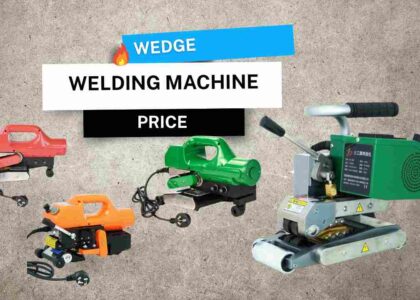
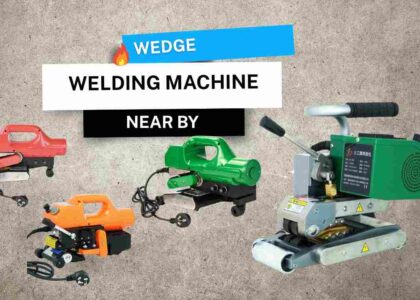
- Standard HDPE 0.8–2.5 mm: the Weldy WGW 300 — 1750 W, 0–8.5 m/min, large rollers for rough subgrade, full dual-track seam.
- Thin liners 0.4–1.5 mm: the Weldy Miniwelder GEO2 — 3.9 kg, chainless drive, ideal for fish farms and water tanks.
- Thick geomembrane 1–3 mm: the IZ-900 and IZ-960 heavy-duty wedge welders.
Compare specifications and budgets in our wedge welder price guide for UAE contractors, or rent a machine for one-off projects.
Hot Wedge vs Extrusion vs Hot Air Welding
Hot wedge welding handles long straight production seams. It cannot weld pipe penetrations, patches or T-junctions — those details belong to an extrusion welder such as the Weldy EX2, while tack welding and pre-heating use a hot air gun like the HT1600 — more on that tool class at our hot air tools site, and on extruders at extrusionwelder.com. Every professional liner crew runs all three; our geomembrane welding machine guide covers how they combine, and this overview of the wedge welding machine range shows every model we supply.
How Hot Wedge Seams Are Tested
- Air pressure test (non-destructive): the channel between the dual tracks is pressurised; a stable gauge reading proves seam integrity along its full length.
- Peel and shear tests (destructive): coupon samples cut from trial welds are pulled apart in a tensiometer; specifications require failure in the parent sheet, not the weld.
We supply and support hot wedge equipment across the UAE, Kenya, Ethiopia, Oman and the wider region — contact us with your liner spec for machine and parameter recommendations.
Frequently Asked Questions
What temperature is used for hot wedge welding HDPE?
Typically 380–450°C wedge temperature for HDPE, adjusted against travel speed and sheet thickness. Trial welds on scrap liner confirm the exact setting for each day’s conditions.
What is combi wedge welding?
Another name for the dual-track seam: two parallel weld tracks with an air test channel between them, produced in a single machine pass. It’s the standard specified seam on QA-controlled geomembrane projects.
How strong is a hot wedge weld?
A correctly executed weld is stronger than the liner itself — destructive peel and shear tests are required to fail in the parent sheet, not the seam.
Can hot wedge welding be done in cold or windy weather?
Yes, better than any other method — the melt zone sits between the sheets, shielded from wind. In cold conditions, crews pre-heat the seam area with a hot air gun and increase wedge temperature slightly.
What speed does a hot wedge welder travel?
Between 0.5 and 8.5 m/min depending on machine and material — thin liners weld fast, thick HDPE slower to allow full melt depth.
Why can’t a hot wedge machine weld patches and pipe boots?
The machine needs a continuous straight overlap to drive along. Curved details, penetrations and repairs are welded by extrusion instead, which deposits molten rod over any joint shape.
About The Author